Delhi Turns Into Fortress Ahead of CJP’s ‘Jantar Mantar 2.0’ Protest
By: Javid Amin | New Delhi | October 10, 2026
The central story is the scale of the security operation and its impact on everyday life in the capital. Reports published on October 10 confirm a deployment of more than 40,000 police and central armed police personnel, restrictions at 45 Metro stations, a temporary mobile internet suspension in a defined area of central Delhi, extensive traffic diversions and railway cancellations. These measures followed the denial of permission for the proposed Cockroach Janta Party (CJP) protest demanding Chief Election Commissioner Gyanesh Kumar’s resignation.
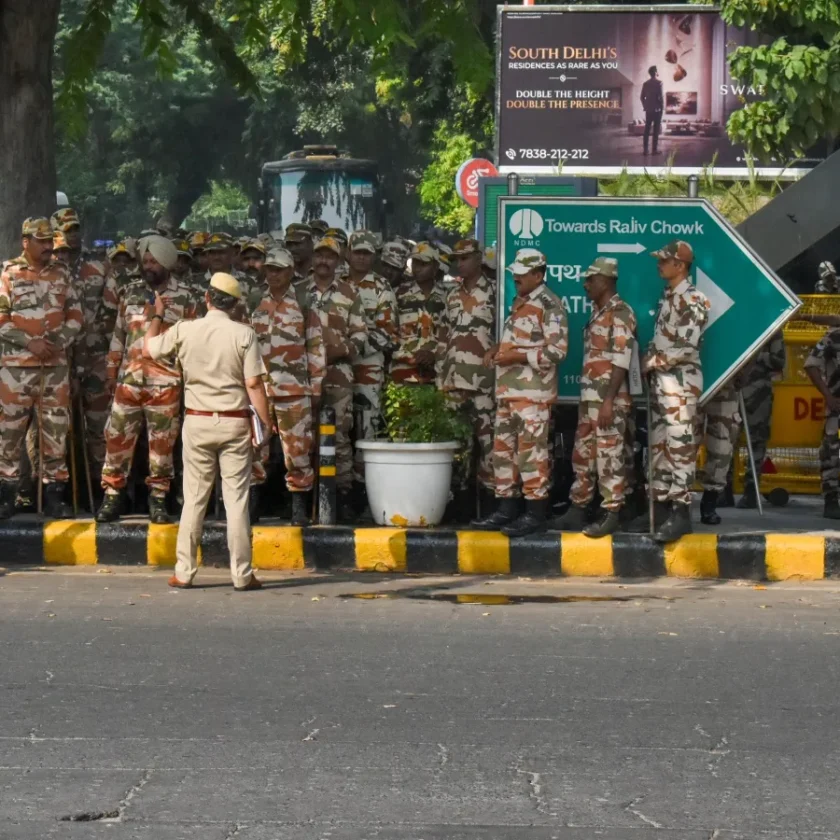
40,000 Personnel Deployed as Jantar Mantar Is Sealed Off
Central Delhi witnessed an extraordinary security presence ahead of the proposed October 10 demonstration. According to Hindustan Times, more than 40,000 personnel from Delhi Police and the Central Armed Police Forces were deployed or expected to be available for the operation.
The report said Delhi Police had assigned more than 15,000 personnel to handle the anticipated gathering, while around 26,000 central force personnel were expected in the capital. Police divided New Delhi district into 20 zones and identified 37 points where demonstrators could potentially attempt to enter restricted areas.
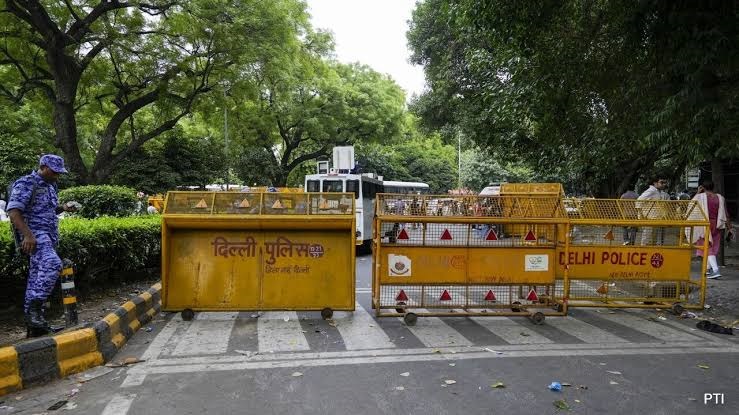
The deployment extended beyond the immediate protest site. Barricades, police vehicles and checkpoints were positioned at key approaches to central Delhi, while officers were instructed to monitor potential gathering points and movement through sensitive areas. The arrangements were designed to prevent a large crowd from converging on the venue after police refused permission for the demonstration.
One of the most significant measures was the temporary suspension of mobile internet services within a four-kilometre radius of the Janpath-Kartavya Path crossing.
According to Hindustan Times, the order was issued on October 9 and scheduled to remain in force from 10 pm that night until 10 pm on October 10. It was issued under the Telecommunications Act, 2023, and the Telecommunications (Temporary Suspension of Services) Rules, 2024. Telecom operators were directed to implement the restriction in the designated area.
Even within that area, however, the practical consequences could be substantial. Mobile connectivity is used for navigation, messaging, digital payments, travel updates and communication between family members. The restriction could therefore affect residents, shopkeepers, journalists and commuters who had no intention of attending the demonstration.
The measure added to the debate over how authorities should balance preventive security arrangements with the public’s ability to communicate and access information.
Delhi Metro Closes Entry and Exit at 45 Stations
The Metro restrictions were revised during the night before the planned protest.
The initial announcement covered 57 stations. The Delhi Metro Rail Corporation subsequently reduced the reported number to 45 stations, where entry and exit facilities were to remain closed from 9 pm on October 9 until 6 pm on October 10, subject to further review. Interchange facilities were to remain available at the affected stations, except at New Delhi Metro station.
The distinction between a station closure and a system-wide shutdown is important. The reported order concerned entry and exit at specified stations; it did not mean that every Metro station across Delhi was closed.
The Metro restrictions also came alongside road diversions, meaning that commuters could not necessarily avoid delays by switching from rail to road transport. Travellers were advised to check current service information and allow extra time for essential journeys.
Delhi Traffic Police issued an advisory warning of possible disruption at around 30 locations, with diversions to be implemented according to the prevailing situation.
The areas identified in reports included stretches around Jantar Mantar, Sansad Marg, Janpath, Ashoka Road, Barakhamba Road, Connaught Place and Patel Chowk. Other affected approaches included Dhaula Kuan, Mandi House, Minto Road and sections of Mathura Road.
For residents, workers and visitors, the combined restrictions created the prospect of longer journeys even when their destination was unrelated to the protest. People travelling to railway stations, inter-state bus terminals and the airport were advised to plan ahead and allow additional travel time.
Although the capital was described in reports as being “sealed” or turned into a fortress, the measures were concentrated around sensitive areas and key routes. The phrase captures the visible scale of the security operation, but should not be taken to mean that every road into Delhi was completely closed.
Hundreds of Train Services Hit by Disruptions
The railways were another major part of the disruption.
The Indian Express reported 245 cancelled services, comprising 75 mail and express trains and 170 passenger services. Other reports put the total above 250 when different categories of local and long-distance services were counted. The totals vary by source and classification, so the figure should not be interpreted as more than 250 long-distance trains alone.
Railway authorities cited the likelihood of severe road congestion around New Delhi and Hazrat Nizamuddin stations during the security operation. Protest organisers, meanwhile, alleged that the wider restrictions would make it more difficult for supporters to reach the capital. These are separate claims: the stated railway rationale was anticipated congestion, while the political criticism concerned the broader effect on participation.
Why Delhi Police Denied Permission for the Protest
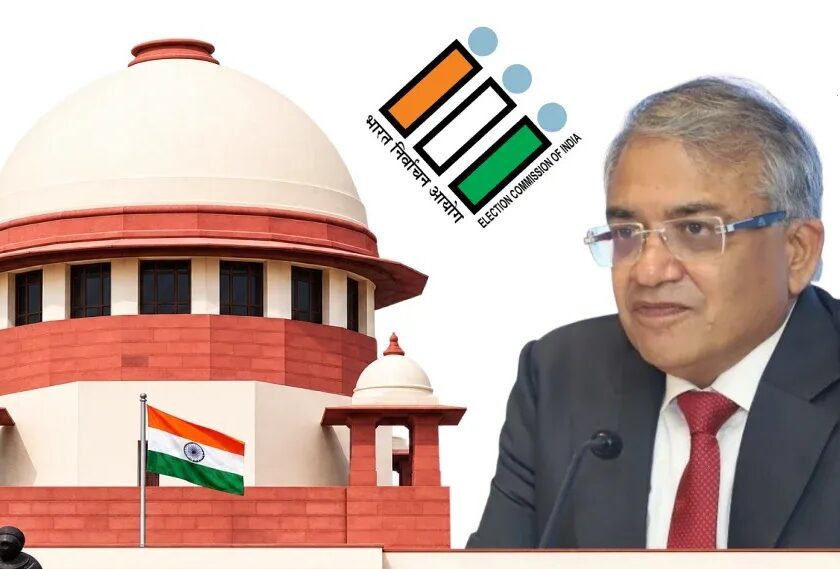
The CJP demonstration was called to demand the resignation of Chief Election Commissioner Gyanesh Kumar over alleged irregularities associated with the Special Intensive Revision of electoral rolls.
Delhi Police denied permission for the proposed gathering at Jantar Mantar. Joint Commissioner of Police Nupur Prasad said applications for demonstrations at the venue should be submitted at least 10 days in advance. Police also cited alleged non-compliance with conditions and undertakings during an earlier protest, alongside law-and-order, public safety and traffic concerns.
The administration’s position is that restrictions are necessary to prevent disorder and protect public safety around important government and constitutional institutions. CJP rejects the denial of permission and argues that the demonstration is a legitimate expression of political dissent.
The dispute therefore goes beyond crowd management. It concerns the conditions under which a political gathering can take place, the discretion authorities exercise over public demonstrations and the extent to which restrictions affect citizens who wish to assemble peacefully.
Abhijeet Dipke Says Protest Is a Democratic Right
CJP founder Abhijeet Dipke criticised the restrictions as he travelled to Delhi to lead the planned demonstration.
Speaking to reporters, Dipke accused Prime Minister Narendra Modi’s government of fearing youth mobilisation and questioned the decision to close Metro access and impose extensive security arrangements. He also maintained that peaceful protest is a fundamental democratic right.
The Constitution protects the right to assemble peacefully and without arms under Article 19(1)(b), subject to reasonable restrictions in the interests specified under Article 19(3). The existence of that right does not automatically guarantee permission for every gathering at any location, but restrictions on assemblies must be assessed in light of their legal basis, purpose and proportionality.
The central question is whether the security arrangements are appropriately tailored to the risks identified by the authorities while preserving meaningful space for lawful political expression.
The SIR Controversy Behind the Mobilisation
The proposed protest is part of a wider political dispute over the Special Intensive Revision of electoral rolls.
Critics have raised concerns about the removal of names from voter lists and alleged that the revision process could affect electoral fairness. The controversy intensified following reports that officials within the election machinery had questioned aspects of the process. Opposition groups have used these concerns to demand greater transparency and accountability from the Election Commission.
Assessing the claims requires scrutiny of official electoral data, the procedures used to revise voter lists, documented objections and the mechanisms available to eligible voters whose names may have been removed. Political allegations alone do not establish that the revision was unlawful, just as an official denial does not remove the need for transparent examination of legitimate complaints.
For CJP, the demand for Gyanesh Kumar’s resignation has become a focal point for a broader argument about electoral accountability. The proposed gathering was intended to bring that dispute into the streets of the national capital.
A Security Operation With Wider Consequences
The events surrounding the proposed CJP protest demonstrate how a major security operation can affect an entire urban area, even when the gathering itself is concentrated at one venue.
The restrictions reached beyond Jantar Mantar, affecting Metro access, mobile connectivity, traffic movement and railway travel. Their impact was felt not only by demonstrators but also by residents, workers, businesses and passengers whose daily plans depended on the normal functioning of the capital.
Authorities have a responsibility to maintain public order and protect people from violence. They must also consider whether restrictions are limited to what is necessary, whether the public receives clear and timely information, and whether essential travel and communications can continue wherever possible.
For the organisers, the issue is the ability to protest against alleged electoral irregularities. For the police, it is the management of a gathering they believe could create serious law-and-order challenges. For ordinary Delhi residents, it is the immediate disruption of transport, connectivity and daily life.
Ultimately, the handling of the protest will be judged not simply by the number of personnel deployed or the number of barricades erected, but by whether public safety is maintained while lawful democratic expression remains possible.